Over the mountain
To get from California's Central Valley to the desert, a train has to climb the Tehachapi Pass, one of the hardest grades in the West, with a loop where the track crosses over itself. In 1932 the line belonged to the Southern Pacific, and the Santa Fe ran over it by agreement. It was the third year of the Great Depression, and many men without work rode the freights from town to town without a ticket.
The storm
According to the U.S. Weather Bureau, a tropical storm moved up the Gulf of California and broke up over land on the morning of September 30. Its warm, wet air kept going northwest, ran into the Tehachapi Mountains and built a huge thunderstorm that sat there all afternoon. The state's flood report recorded 4.38 inches of rain at Tehachapi between 1:30 and 8:00 p.m. It fell on hillsides grazed bare by cattle.
Woodford
Below the loop, the line drops through a canyon to Woodford: a small station, a siding and, by the road, Peter Kaad's service station and lunch counter, where he lived with his wife Louise and their young son. That evening two freights were waiting there, one Southern Pacific and one Santa Fe with locomotive 3834. Tehachapi Creek was rising. People came in to shelter, at least fifteen of them at the service station, according to one newspaper. It looked like the safest place around.
Nobody knows the exact time. Two victims were found with their watches stopped at 8:16. According to the state engineers, logs and debris jammed in the concrete culvert under the track, building an almost watertight dam. The water rose behind it, and then the fill burst all at once. The wave took the lunch counter, the service station and everyone inside.
How many died in the flood
Newspapers reported 25 or 30 dead, then as many as 50, and even 21 bodies in a single boxcar, which turned out to be false. The state's official report and the Weather Bureau both give at least 15. A present-day researcher identifies 16 by name and 6 more who were never identified. Among them were the Kaad family, Southern Pacific engineer A. H. Ross, brakeman Harry Moore, and the telegraph operator at Caliente with her granddaughter. On October 6, six unnamed men, probably transients riding the trains, were buried in Bakersfield.
The lost engine of Tehachapi
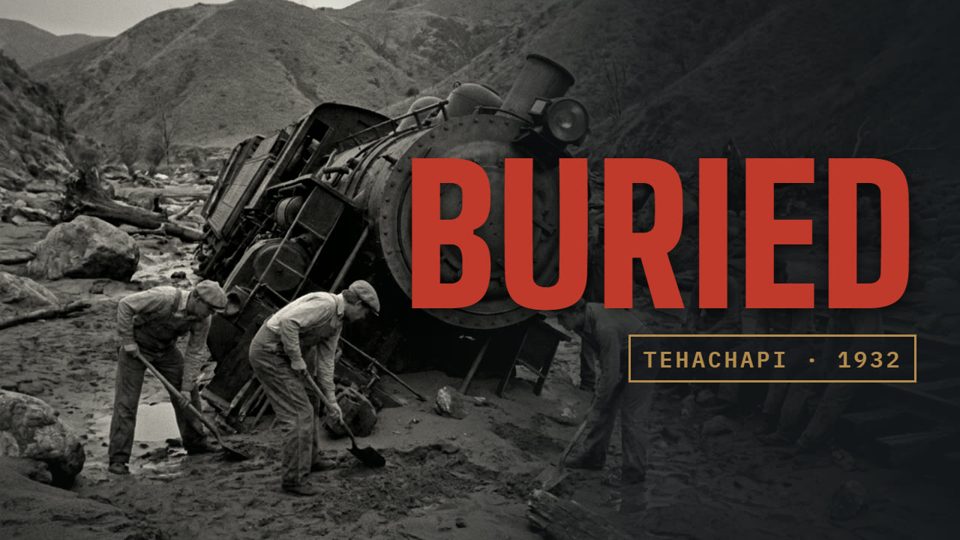
Santa Fe 3834 had vanished. Accounts differ on how it was found: the Bakersfield Californian reported on October 5 that it lay under sand and rock about 40 feet from the track; later accounts speak of two weeks and ten feet of mud. Getting it out was the hard part. A temporary track had to be laid into the canyon so cranes could reach it, and salvage began on October 24.
Almost any other locomotive would have been scrapped. The Santa Fe had it rebuilt, and nearly three years after the flood, No. 3834 crossed the Tehachapi Pass again. According to local history, people lined the track at Tehachapi and Keene to cheer it home. It rang a new bell as it went by, because the original wasn't there when it came out of the mud. As far as anyone knows, it was never found.
Sources
California Department of Public Works, 1933 flood report; Bakersfield Californian, Oct. 1–5, 1932. The full list of sources is in the description of the video.